Human duels are formalised conflict. Historically this involves one aristocrat with funny tights insulting another aristocrat with funny tights. The former – let’s call him “Hooray” – slaps the latter – let’s call him “Henry” – with a pair of lily-white gloves. A challenge issued: choose your instruments. Meet at dawn. Duel. A victor. Honour restored.
Such an example might be the Italian composer Carlo Gesualdo. Discovering that his wife, Maria d’Avalos, was having an affair with the Neapolitan nobleman Fabrizio Carafa, the cuckolded composer might reasonably have issued a challenge: dawn; swords; nobleman killed; honour restored.
However, Gesualdo simply burst into the bedroom with his trusty sword and even more trustworthy armed servants and murdered the lovers where they lay. Because he was a powerful aristocrat, the episode was treated as an “honour killing” and he was never prosecuted. Renaissance justice could be wonderfully efficient.
But bloke-cats conduct their own rooftop duels. Territorial disputes. The shrieking rivalry of fighting toms gave the English word “caterwaul”, which later writers used for noisy musical contests. Then there is the term “catfight” which is often used to describe a noisy, theatrical quarrel. A mock duel.
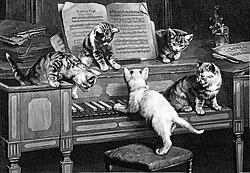
And then there is Domenico Scarlatti’s Keyboard Sonata in G minor, K.30: the “Cat’s Fugue”. But why?
Well folklore tells us that Scarlatti’s cat supposedly walked across the keyboard, producing the unusual opening theme. A lovely and plausible anecdote, but an unlikely one too. A more realistic association is that the sonata begins with a four-voice fugue subject that leaps dramatically across the keyboard. Thus the radical chromatic movement, angular melody and large intervallic leaps – jumps of two or three octaves – are the likely source of the cat legend. The result is almost a duel between the hands, each chasing the other across the keyboard.
This is all well and good, but did Scarlatti ever duel in earnest?
The eighteenth-century music historian Charles Burney later recorded a musical “duel” between Scarlatti and George Frideric Handel for the Cardinal Pietro Ottoboni in Rome around 1708. A challenge was issued and the instruments chosen. The initial contest on harpsichord was adjudicated a score draw, but on the organ VAR declared Herr Handel the victor.
Anyway, does the sonata merit its feline nickname? Fortunately you can judge for yourselves.
Pianist David Hammond will be performing the Sonata – alongside Patrick John Jones’ Eel, Dawn Walters’ Petaloudes (Valley of the Butterflies) and James Else’s tribute piece, Kitten’s Prelude – in a recital on Saturday 21st March at 1.00pm. Visit York Late Music for ticket and full programme details.