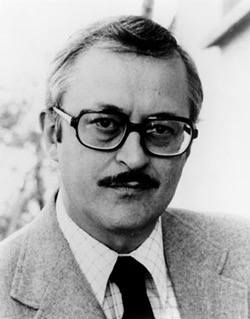
Robert Muczynski, musical independence – and the his musical language he refused to soften
In the early 1950s, a young American composer arrived in Los Angeles with the kind of skillset Hollywood prized: a formidable pianist, a sharp ear, and a gift for writing music that communicated instantly – clear, economical, and precise.
He was not alone. Others made the same journey – and stayed, adapting their voices to the demands of the studio system. Some, like Bernard Herrmann, bent that system to their will – his scores work perfectly well in abstract performance. Others learned like Elmer Bernstein learned to move within it, shifting style according to the needs of the film – The Magnificent Seven vs To Kill a Mockingbird.
Bernstein was classically trained, initially interested in concert music
- Adapted quickly to studio demands
- Could shift style depending on the film (The Magnificent Seven vs To Kill a Mockingbird)
Robert Muczynski took a different path.
To try and understand why, it helps to listen not just to his story, but to his music—and the musical world he was quietly absorbing and resisting at the same time.
A composer who wrote from the keyboard
Muczynski’s music is unmistakably pianistic. In works like Piano Sonata No. 3, Op 35 – here performed by Zachary Lopes or the Time Pieces for Clarinet and Piano, Op. 43 (1983) – here (impressively) performed by Andrea Caputo, clarinet and Florian Podgoreanu, piano, you hear:
- Clean, muscular textures
- Driving rhythmic cells
- Transparent, almost architectural phrasing
There are echoes of:
- Prokofiev’s percussive attack
- Bartók’s rhythmic bite
- Hindemith’s structural clarity
But Muczynski pares these influences down. The result is leaner – more controlled, less overtly expressive. And not as great.
Tonal – but never comfortable
Mid-century classical music was splitting into camps.
On one side: the path instigated by Arnold Schoenberg—atonality, and later serialism.
On the other: composers like Stravinsky, Hindemith, and Bartók, who retained clarity, rhythm, and structure without abandoning tonality altogether.
Muczynski stood much closer to the latter tradition.
If you listen to Time Pieces for Clarinet and Piano (Op 43):
- The harmony is tonal – but unsettled
- The rhythm is taut, almost clipped
- The gestures are concise, rarely allowed to develop in a Classical sense
And then – almost underneath it all – you catch something else.
Just a hint of another language.
The trace of jazz – without the idiom
Muczynski doesn’t “do jazz” in any overt sense.
There’s no swing, no walking bass, no borrowed standards.
But listen closely and you begin to hear:
- Syncopations that feel slightly off-centre
- Phrases that land just around the beat rather than squarely on it
- Harmonic colours that hover between major and minor
Not jazz as style – but an echo of its rhythmic edge and harmonic colour..
Where someone like Gershwin brings jazz to the foreground, Muczynski admits only traces of its rhythm and colour.
Hollywood: where music serves the image
Now place that voice inside 1950s Hollywood.
Muczynski wasn’t alone. In fact, mid-century Hollywood was full of composers—American and émigré—arriving with serious classical credentials.
Film composers like Bernard Herrmann (Vertigo) and Miklós Rózsa were doing extraordinary work – but within constraints:
- Music followed narrative pacing
- Emotional cues were often prescribed
- Deadlines were unforgiving
The system depended on collaboration – and compromise.
Young composers entering the industry typically didn’t begin with full authorship. They:
- Orchestrated for others
- Arranged cues
- Worked without credit
Muczynski entered that world – and quickly recognised it wasn’t for him.
The absence of film credits
There is no catalogue of major film scores under his name.
There are suggestions, passed on by clarinettist Lesley Schatzberger, that he may have contributed music to films by his partner, Harry Attwood – though these remain undocumented and, if they survive at all, largely obscure. His Fantasy Trio, Op. 26 is dedicated to Attwood, hinting at a personal connection to that world without a sustained professional presence within it.
Even so, there is no sustained presence in film – and that absence is revealing.
Because when you listen to his concert works, you hear a composer who:
- shapes rhythm with precision
- avoids obvious emotional signalling
- maintains tight control over pacing and gesture
Even the faint jazz inflections never loosen into improvisation. Every gesture is carefully controlled.
What his music tells us about his decision
Take the Andante of his Flute Sonata, Op.14:
- Lyrical – but restrained
- Expressive – but unsentimental
Or the shifting accents in Time Pieces:
- Restless
- Self-contained
- Edged with something almost conversational – but fully composed.
These aren’t gestures designed to follow dialogue or underline a scene.
They’re statements.
And statements require ownership of the author.
🌵 Choosing a different centre
Instead of staying in Los Angeles, Muczynski built his career in Tucson.
At the University of Arizona, he taught, composed, and refined a catalogue marked by consistency.
No stylistic pivots.
No overt borrowing.
No concessions to fashion.
Even those subtle traces of jazz remain just that – traces. Never adopted, never expanded into something more commercially legible.
🎶 The paradox of accessibility
Muczynski’s music is often described as “accessible.”
But that word can mislead.
Okay, it’s:
- Tonally grounded
- Clearly structured
- Immediately engaging
But it resists easy emotional direction.
Unlike much film music – and unlike jazz in its freer forms – it doesn’t guide you toward a feeling or invite improvisation.
It presents, but does not seek to persuade.
Restraint as an artistic position
Later in life, Muczynski slowed – and then largely stopped – composing.
Not out of decline – but out of decision.
His catalogue remains relatively compact, but quietly original.
Even the influences you can hear – Bartók, Prokofiev, the faintest shadow of jazz – are never allowed to dominate.
A different measure of success
We often measure composers by output, visibility, or cultural footprint.
By those standards, Muczynski appears modest.
No film legacy.
No stylistic “movement.”
No mass recognition. Probably the opposite.
But listen closely, and another metric emerges:
- Precision over quantity
- Independence over visibility
- Control over stylistic alignment.
Not radical, but certainly a voice of integrity and authenticity.
Robert Muczynski’s Fantasy Trio, Op.26 will be performed by Amabile – Lesley Schatzberger (clarinet), Nicola Baxter (cello) and Paul Nicholson (piano) – as part of the York Late Music 2026 concert series on Saturday 11th April.
For tickets and programme details, visit: York Late Music.
If you’d like more essays like this, you can subscribe to An Outsider’s Perspective.