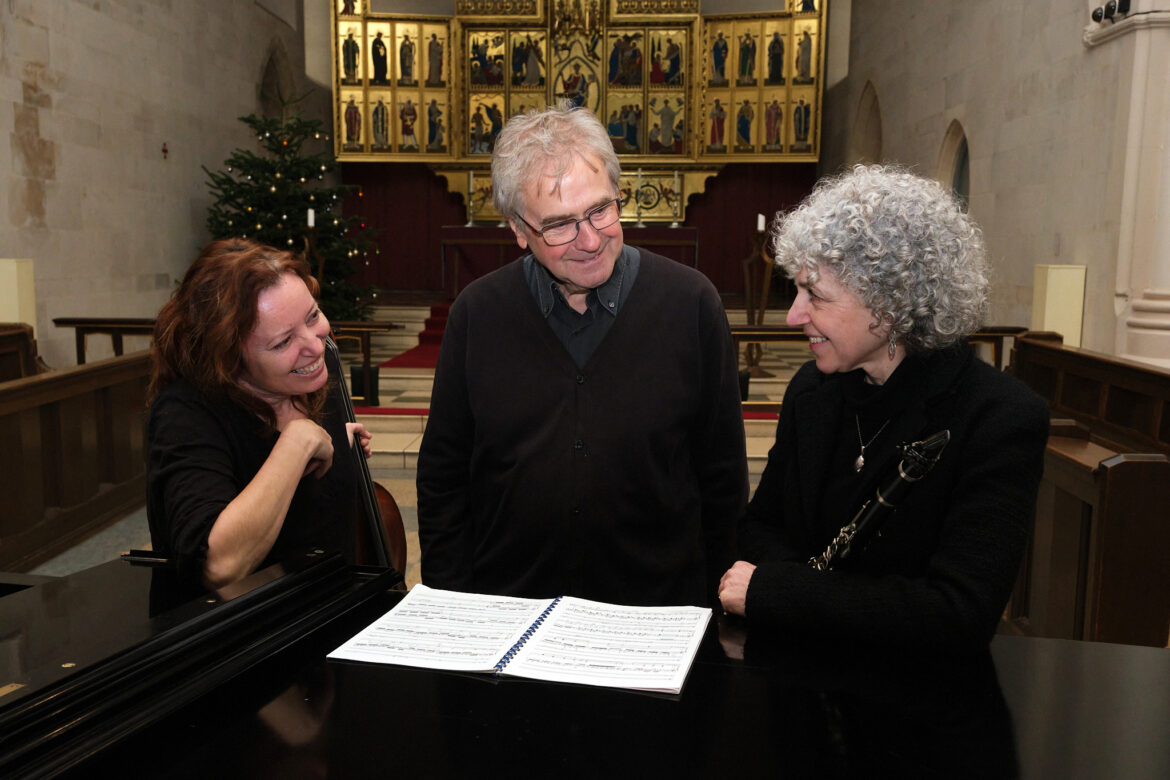
Amabile Clarinet Trio
Lesley Schatzberger (clarinet), Nicola Tait Baxter (cello) and Paul Nicholson (piano)
Saturday 11th April, 7.30pm
York Unitarian Chapel
Amabile clarinet trio returns to York Late Music with a diverse programme of music from the brand new (2026) back to 1896, stopping off in the 1980s and 1950s along the way. Most of the pieces are by British composers, with the American Muczynski and the German Zemlinsky joining the party. There is music inspired by song, by relationships, and by the passing of time. There is introspection, contemplation, anger, energy. How better to express a panoply of human experience than through music.
There will be a preconcert talk at 6.45pm by David Lancaster – with a complimentary glass of wine or juice.
Programme
Thea Musgrave: Canta Canta!
Steve Crowther: Morris Dances
Nicola Lefanu: Lullaby
Nicola Lefanu: Nocturne
David Power: New work (première)
Robert Muczynski: Fantasy Trio, op.26
Interval
David Lancaster: Canzone Sospesa
Alexander Zemlinsky: Clarinet Trio, op.3
Thea Musgrave: Canta Canta!
This short piece is taken from A Cantata for a Summer’s Day written in 1954, towards the end of her time in Paris. The poems of the Cantata describe a summer’s day: the original song is a setting of a poem by Maurice Lindsay which describes the orange tiger lily burning bright in the hot summer sun.
Lesley Schatzberger
Steve Crowther: Morris Dances
Morris Dances was originally written in 2012 as a solo piano piece dedicated to Steve Crowther’s friend Philip Morris. The piano piece takes the form of a theme with 11 variations, all personal in nature. In 2024 the composer transcribed five of the variations for clarinet, cello and piano, adding one more in 2025. He describes these thus:
A Song of Innocence 1 (for George)
The world seen through a child’s eyes – pure, full of wonder, and trusting.
Simple and playful.
Parting of the Ways? (for Eileen and Michael)
A lover’s tiff – perhaps: somewhat heated, hurt, unresolved.
A Moment Passes (for Noëlle)
Written for Noëlle, a Buddhist who, at the time, was living with AIDS. Her meditative ritual was a deep source of spiritual truth and renewal – a continual reaffirmation of wholeness.
A Song of Experience (for Roger McMeeking)
The world as perceived by an adult – conscious of suffering and hypocrisy. Darker in tone, touched with irony and the ghost of jazz.
Emma Walks (for Emma)
A second song of innocence – my daughter Emma taking her first tentative steps.
Love Song (for Absent Friends)
A quiet remembrance – a tender and reflective dance.
Steve Crowther
Nicola LeFanu: Lullaby (clarinet and piano); Lullaby (cello and piano)
These two short night pieces, composed in 1988, are linked in their material but somewhat different in their approach. In the clarinet duo it is as if a mother talks to her child at bedtime. The duo is a collection of tiny miniatures: the fast music is peopled with the characters of bedtime stories; in the slow music the mother watches her sleeping child.
The cello duo is further into the night. It is one continuous song, in which the mother sings as much for herself as for the child.
Nicola LeFanu
David Power: Candidate – WP
This short piece for Bb clarinet, cello and piano was written at the request of Amabile and I am grateful to them for this opportunity. The piece is a ‘tune and accompaniment’ work with the piano forming the accompaniment and the clarinet and cello – sometimes doubling each other and sometimes not – providing the tunes. I fear I am unable to explain the title which just pinged into my head and stayed there during the course of composing the piece but seems none the worse for that.
David Power
Robert Muczynski (1929-2010): Fantasy Trio, Op.26
Allegro energico
Andante con espressione
Allegro deciso
Andante molto e sostenuto – Allegro
The Fantasy Trio, which he wrote in 1969 at the request of colleagues in Tucson, is a compact work in four movements. Despite Muczynski saying in a 1987 interview with classical music radio presenter Bruce Duffie ‘This is one of my big chamber works’, the piece is concise, lasting only about 13 minutes. In the same interview, he said ‘I prefer to lean toward the more succinct or terse kind of writing. I just feel there is no point in padding this piece. If I’ve made my statements, then let’s get off and that’s it!’ His compositional style is recognisably mid 20th century American – basically tonal and neoclassical, with plenty of rhythmic energy, but that is not to say that it lacks an emotional palette. The Fantasy Trio is dedicated to the film maker Harry Atwood, who was his long-time partner, and for whom he also wrote nine film scores.
Lesley Schatzberger
Interval
David Lancaster: Canzone Sospeso UKP
Canzone Sospesa, for cello and piano, explores the way that time passes. It was composed in the summer of 2023 when I was also making a song setting of Dylan Thomas’ lyric poem ‘The force that through the green fuse…’ and both are concerned with the passing of time and how it simultaneously creates and destroys us. At times the music presses relentlessly forward but elsewhere movement seems suspended (even though for the performers the tempo remains constant throughout). Canzone Sospesa was completed in Aulus-les-Bains, high in the Pyrenees – where time sometimes seems to stand still – and was first performed in Teatro dal Verme, Milan, in November 2023 by members of Trio Chimera.
David Lancaster
Alexander von Zemlinsky (1872-1942): Trio in D minor, Op.3
Allegro ma non troppo
Andante
Allegro
The opening movement of the clarinet trio is expansive, and whilst it shows the influence of Brahms, it could not be mistaken for Brahms’s music. We have passion, turbulence, and shifting chromatic harmonies. This is followed by a songful andante with moments of fantasy, and then a brief, urgent and agitated finale with a slightly surprising coda.Lesley Schatzberger