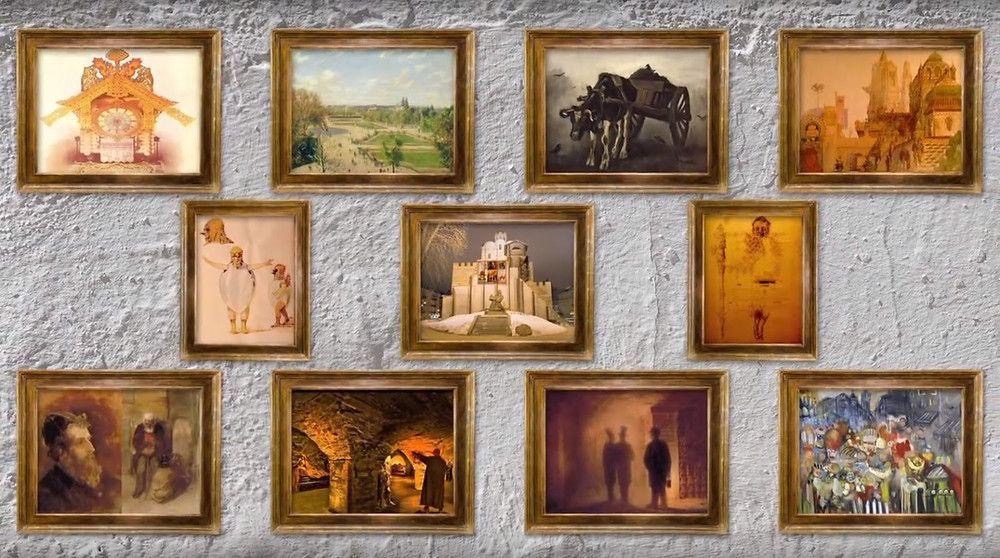
The “programmatic idea” behind Pictures at an Exhibition by Modest Mussorgsky is – quite literally – a musical walk through an art exhibition.
In 1874, Mussorgsky composed the piano suite after visiting a memorial exhibition of works by his friend, the artist and architect Viktor Hartmann, who had recently died. The music is his emotional and imaginative response to specific pictures. Each movement, therefore, is his response to a particular artwork by Hartmann.
The “Promenade” idea is a recurring theme representing Mussorgsky moving through the gallery. Importantly, it changes each time, reflecting his evolving response to the works he encounters.
The original structure of the piano suite is as follows:
Promenade I
Gnomus– a grotesque, jerky dwarf-like figure, depicted through distorted rhythms and harmonic instability.
Promenade II
The Old Castle – a medieval scene with a sad troubadour, conveyed through a long, melancholic melody.
Promenade III
Tuileries– children arguing in a Paris garden; light, quick, and playful in tone.
Bydło – a heavy ox cart; a loud, lumbering procession.
Promenade IV
Ballet of the Unhatched Chicks – chicks dancing in their shells; quick, delicate, humorous, almost absurd.
Samuel Goldenberg & Schmuÿle – two contrasting Jewish characters, one rich, one poor. Mussorgsky deploys the left hand (lower register, heavy chords, slow, deliberate rhythm) to create the grounded, imposing authority of the rich man, Goldenberg. Schmuÿle, the poor man, appears in the right hand: stuttering repeated notes, staccato articulation, and a twitchy rhythm – a fragile, agitated character.
Limoges – women in a market gossiping, arguing, overlapping; multiple voices talking at once. The tempo is fast, the phrases fragmented, and the articulation light and staccato.
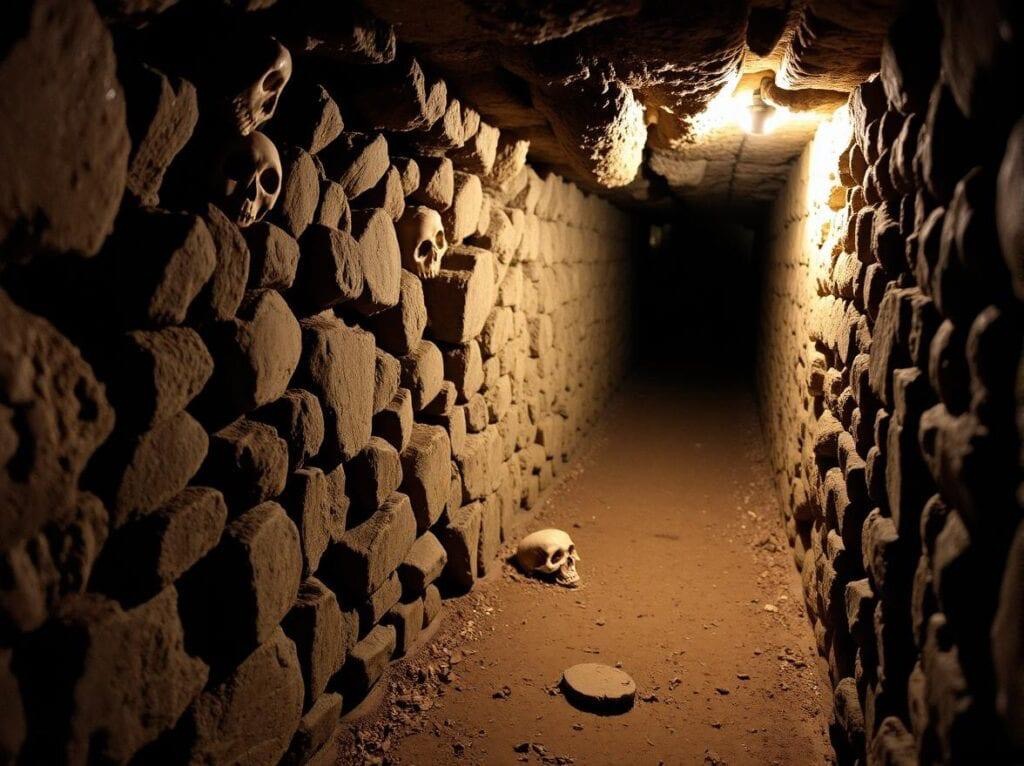
Catacombae – as we enter an underground chamber of death, Mussorgsky’s piano writing settles into stillness and awe: deep, resonant bass chords, slow and heavy, with the pedal creating a blurred, hollow sonority.
Promenade V → Cum mortuis in lingua mortua (transformed)
Baba Yaga – the witch from Russian folklore. A terrifying pursuit: wild, grotesque, and relentless. Mussorgsky uses powerful repeated chords, a driving tempo, and extreme dynamic contrasts to evoke something supernatural and menacing – Ms Yaga is actually a “hut on fowl’s legs.”
The Great Gate of Kiev – rich, resonant harmonies create a triumphant, monumental, and radiant conclusion.
The genius of Mussorgsky’s design is that it can be endlessly reimagined: not tied to one exhibition, but to the experience of walking, observing, and reacting. Which brings us neatly to a rather different gallery…
Now, ladies and gentlemen, if you could please follow me into the TARDIS, you will be transported to our current Pictures at an Exhibition, curated by composer Nick Williams.
Here is the exhibition layout:
Igor Stravinsky/Nick Williams: Pour Picasso / Picasso Promenade 1
Murphy McCaleb: A Summer’s Day (1st performance)
Stravinsky/NW: Pour Picasso / Picasso Promenade 2
Ben Gaunt: The Last Man (1st performance)
Stravinsky/James Williamson: Pour Picasso / Picasso Promenade 3
James Williamson: Lone Yellow II (1st performance)
Stravinsky/NW: Pour Picasso / Picasso Promenade 4
Art Songs arranged by Nick Williams:
- Artists Only (David Byrne/Wayne Zieve/Talking Heads)
- Dali’s Car (Captain Beefheart and the Magic Band)
- Andy Warhol (David Bowie)
- Vincent van Gogh (Jonathan Richman and the Modern Lovers)
INTERVAL
Stravinsky/JW: Pour Picasso / Picasso Promenade 4
James Williamson: Lone Yellow II (version 2)
Modest Mussorgsky arr. Nick Williams and Tim Brooks: Pictures at an Exhibition
Different pictures, different composers – but the same journey: walking, looking, and listening as each image comes to life.
The exhibition opens on Saturday 2nd May at 7.30pm. Nick will give a pre-exhibition talk at 6.45pm, accompanied by a complimentary glass of wine or juice.
For tickets and further details, please visit: York Late Music.